
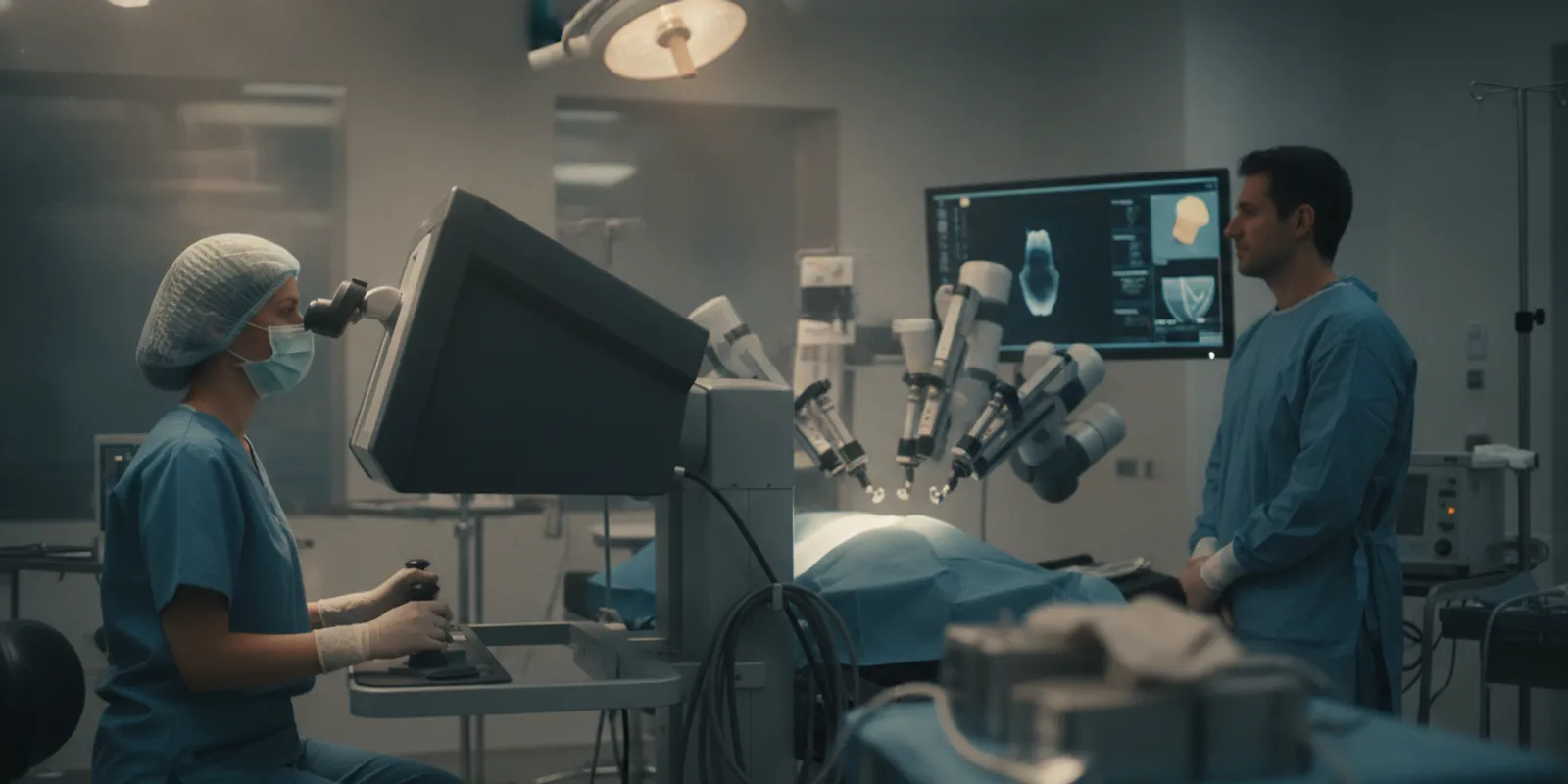
Single incision robotic surgery is a minimally invasive technique in which a surgeon performs a selected operation using a robotic system and a single planned access site. The term describes how instruments enter the body; it does not promise a particular result, less pain, or a faster recovery. Whether it is appropriate depends on the operation, anatomy, health history, and the surgeon’s assessment.
Request a surgical consultation
What does single-incision robotic surgery mean?
In many minimally invasive operations, a surgeon uses several small openings for a camera and instruments. With a single-incision approach, the team plans to introduce the camera and working instruments through one access site. That site is often near the navel, but its location and arrangement depend on the operation and the system being used.
Robotic surgery describes how the surgeon controls certain instruments. The surgeon sits at a console and directs movements while viewing the operative area on a screen. The robot does not make decisions or perform the operation on its own. The surgeon remains responsible for planning, instrument control, and decisions throughout the procedure. An assistant at the bedside and the rest of the operating team support the work.
The phrase “single incision” can be used broadly, so it is worth asking what it means for the specific procedure. Some systems pass multiple instruments through one access port or cannula. Others may require a different arrangement, and a surgeon may add another access point if needed. A single planned site is not a guarantee that no other opening will be necessary.
For a technical example, the professional society AAGL describes a single-port robotic approach in which instruments are introduced through one port using a cannula in its overview of single-port robotic surgery. That description illustrates one system and context; it should not be taken to mean every operation or platform uses an identical setup.
How does the technique work?
The broad phases resemble those of other operations: the team prepares the patient, creates the planned access, completes the intended surgical work under camera guidance, checks the operative area, and closes the incision. The specific steps vary with the body area and purpose of surgery. Because several instruments may work through a shared site, their positioning and range of movement have to be managed carefully.
- Preoperative planning: The surgeon reviews the reason for the operation, relevant health history, medications, previous procedures, examination findings, and tests when indicated. The consultation includes a discussion of the intended approach and alternatives.
- Anesthesia and operating-room setup: The anesthesia and surgical teams prepare for the procedure. The robotic equipment, camera, and instruments are positioned and checked before the operation begins.
- Establishing access: The surgeon makes the planned incision and places the access device or instruments. The site, size, and equipment depend on the procedure. A camera provides a view of the working area.
- Performing the operation: The surgeon controls the robotic instruments from the console and works on the planned surgical task. The bedside assistant supports the operation, and the team communicates as the work proceeds.
- Checking and closing: The surgeon checks the operative area, removes instruments, and closes the incision. If the view, access, or safety needs require it, the surgeon may use an additional port or change to another approach.
The final point is an important part of planning rather than a failure of the technique. Conditions seen during an operation can differ from what was expected. A surgeon may adjust the plan to maintain visibility or complete the procedure safely. Before surgery, ask what changes might be considered and how the surgeon would make that decision.
What may be different about one access site?
The most visible difference is the planned access pattern: a single-incision technique aims to use one principal site rather than several separate sites. This may appeal to someone who prefers fewer visible incision locations. The robotic system also provides a camera view and instruments controlled by the surgeon, but those features are not unique proof that a single-site operation will be best for a particular person.
In a single-site arrangement, the instruments enter close to one another. That can make instrument spacing and movement more challenging than when instruments come through separate ports. The surgeon needs to maneuver the tools, maintain a useful view, and reach the anatomy involved in the operation. The right access pattern is the one that gives the team a workable and appropriate way to perform the required task.
It helps to distinguish three questions that are sometimes blended together: Is surgery needed? Which operation is appropriate? What access method should be used to perform it? Robotic equipment and incision count address the method question; they do not decide whether an operation is necessary or replace discussion of the operation’s purpose and alternatives.
Eastside Bariatrics & General Surgery provides information about its robotic surgery services. For your own consultation, ask the surgeon whether the proposed operation is planned as single-incision, multiport robotic, laparoscopic, or open, and what the selected approach is intended to accomplish.
What potential advantages and limitations should you weigh?
One possible appeal is having one principal access site instead of several separate sites. A robotic platform may also provide a magnified view and articulated instruments. These are features of a technique, not a promise of less pain, fewer complications, a better cosmetic result, or an earlier return to normal activities. Such outcomes depend on many factors, including the operation, the patient’s health, the course of surgery, and healing.
The tradeoffs matter just as much as the possible appeal. Instruments placed through one site can crowd each other or have less convenient angles. A surgeon may find that a multiport method offers better separation, access, or flexibility for a particular task. A single site may also be unsuitable for some operations or for some individual anatomies.
- Access and visibility: The surgeon needs a clear view and a practical way to reach the anatomy. One access point may work well in some circumstances and be limiting in others.
- Instrument movement: Tools sharing an access site have to move without interfering with one another. The available movement depends on the system, port arrangement, and surgical task.
- Procedure requirements: A technique that is feasible for one procedure may not meet the needs of another, even if both are described as minimally invasive.
- Individual factors: Prior surgery, scar tissue, anatomy, medical conditions, and other findings may affect what approach a surgeon considers appropriate.
- Possibility of a change: An additional port or a different approach may be needed if circumstances during surgery make that the appropriate choice.
When discussing benefits, ask for the expected advantage in your specific case and what evidence or experience informs that recommendation. Then ask what limitations are relevant and whether a different approach could better support the surgical goal. A balanced discussion should include uncertainty rather than treating the number of incisions as the only measure of success.
Who may be a candidate for the approach?
Candidacy is specific to the operation and the person. A surgeon considers why an operation is being proposed, what must be done during it, and whether a single-incision setup can provide adequate access and control. A general description online cannot establish whether an individual is a candidate.
During an evaluation, the surgeon may review:
- The diagnosis or reason for the proposed procedure and its intended goals.
- Medical conditions, current medications, allergies, and relevant anesthesia considerations.
- Previous abdominal or other relevant operations and any known scar tissue.
- Examination findings and imaging or other tests when they are indicated.
- The anatomy and surgical steps involved in the planned operation.
- Whether another minimally invasive approach or an open operation may better fit the task.
Two people with a similar diagnosis may receive different recommendations. Their medical histories, anatomy, prior procedures, and operative needs may differ. The recommendation may also depend on what the surgeon expects to accomplish and what access will support that work. A surgeon can explain which factors matter in the individual case without assuming that one incision pattern fits everyone.
If you are exploring the broader options available through the practice, review its surgical services page and ask which service relates to your concern. The page is a starting point for discussion, not a determination of candidacy or a substitute for an examination.
How does the surgeon choose among approaches?
Approach selection starts with the purpose and technical needs of the operation. The surgeon considers how to reach the operative area, see it clearly, and complete the necessary work. The number of incisions is one factor, but it does not stand alone. The choice may involve single-incision robotic surgery, multiport robotic surgery, conventional laparoscopy, or open surgery, depending on the procedure and patient-specific considerations.
| Approach | General access pattern | Point to discuss |
|---|---|---|
| Single-incision robotic | One planned principal access site, with instrument arrangement varying by system and procedure | Can the planned task be performed with adequate view, reach, and instrument movement? |
| Multiport robotic | Several access sites for the camera and instruments | Would separate access points provide useful instrument spacing or flexibility? |
| Conventional laparoscopy | Several access sites with instruments controlled directly by the surgeon | What makes this approach appropriate for the operation and the surgeon’s plan? |
| Open surgery | A larger incision provides direct access to the operative area | Under what circumstances could direct access be more practical or appropriate? |
This table is a general orientation, not a ranking. It does not show that one method is safer or better for every procedure, and it does not predict a particular person’s outcome. Compare approaches for the same planned operation, and ask the surgeon to explain how each option relates to the goals, access needs, and relevant individual factors.
A useful recommendation should make the reasoning understandable. You should be able to ask what the proposed technique allows, what it may make harder, what alternatives are reasonable, and what circumstances could change the plan. If those points are unclear, ask for them to be explained in everyday terms before deciding how to proceed.
What should you ask before deciding?
A consultation is a chance to understand both the planned operation and the proposed access method. Consider bringing a current medication list, a summary of relevant past procedures, and questions written down in advance. If you have records or imaging from another clinician, ask whether they would be useful to the evaluation. The practice’s about page provides background on the practice; the consultation is where the team can address your own medical circumstances.
- What is the goal of the operation, and what alternatives are appropriate?
- Are you recommending a single-incision approach for this specific operation? What is the reason?
- What does “single incision” mean in the planned technique and with the equipment being used?
- What factors in my health history or anatomy affect the recommendation?
- What limitations or risks should I understand for each option?
- Could you use an additional access site or change to another approach? What might lead to that decision?
- What should I expect during the operation and immediately afterward?
- What instructions, follow-up, and restrictions might apply to recovery?
- What information or testing is still needed before the plan is finalized?
These questions can help turn a broad discussion of technology into a conversation about your actual care. If you are comparing recommendations, make sure you are comparing the same operation and the same goals. You can ask each clinician to explain the reasoning and the alternatives in language you understand.
What can recovery involve?
Recovery depends on the operation and the individual, not simply on whether the surgeon used one access site or several. The procedure itself, health conditions, anesthesia, the findings during surgery, and the person’s healing can all affect the plan. For that reason, a recovery timeline from someone who had another operation may not apply to you.
Before leaving the care setting, make sure you understand the instructions provided by your team. Depending on the procedure, instructions may cover incision care, activity, eating and drinking, medications, and follow-up. Ask what is expected, what should prompt a call to the care team, and whom to contact with routine questions. Follow the specific guidance given for your operation rather than relying on a general online schedule.
Practical planning can make the first part of recovery easier. Ask in advance whether you will need someone to take you home or assist with everyday tasks. Confirm when you may resume driving, work, exercise, lifting, and other usual activities; the answer can differ by procedure and by how healing progresses. If responsibilities at home or work affect planning, raise them during the consultation so the team can explain what to expect.
Fewer visible incision sites do not remove the need for follow-up or the possibility of restrictions. Nor can an online article determine whether a particular symptom after an operation is expected. Use the instructions and contact information provided by your treating team. In an urgent medical emergency, call 911 or go to the emergency room.
How can you prepare for an approach discussion?
It can help to organize the consultation around the operation rather than the device. Begin by making sure you understand why the procedure is being considered and what the surgeon hopes it will address. Then discuss the planned access method. This order matters: an access technique is a way to perform an operation, not a treatment goal by itself. If the reason for surgery or the intended result is not clear to you, pause to clarify that before comparing incision patterns.
Before the visit, write down relevant details about your health history. Include prior operations, current medicines and supplements, allergies, and health conditions you believe may affect treatment. The care team can tell you which records or test results would be useful. Do not stop or change a medication based only on general reading; ask the clinician who is managing your care for individual instructions.
During the conversation, it may be useful to repeat the plan in your own words: what operation is proposed, how the surgeon expects to access the area, and what alternatives were discussed. That gives the surgeon an opportunity to correct misunderstandings. If you hear “single incision” but are unsure how many ports or instruments may be used, ask for a plain-language explanation of the planned arrangement.
You can also ask what would lead the team to change the plan. For example, the surgeon may explain that the view, access, or findings during an operation can affect the approach. This is a general possibility, not a prediction that a change will happen. Understanding the possibility beforehand can make consent discussions more useful and help you know what you are agreeing to.
How should you compare the recommendation with alternatives?
Try to compare approaches using the same questions rather than relying on broad impressions such as “newer,” “smaller,” or “less invasive.” Ask what each method is intended to accomplish for the procedure being considered. Ask what access it provides, what challenges the surgeon anticipates, and what tradeoffs matter most in your circumstances. The appropriate comparison is patient-specific and procedure-specific.
For instance, a person focused on the number of visible incision sites may want to know whether one principal access site is feasible. The surgeon still has to consider whether the instruments can reach the operative area and whether the view and movement are adequate. Another person may place more importance on the method the surgeon considers suitable for the planned work. These are different concerns; the consultation can help address both without promising a particular outcome.
When you hear a potential advantage, ask what it means in practice. Is the statement about the incision pattern, the view, the instruments, or a patient outcome? Those are not interchangeable. A single access site describes an access plan. It does not establish that pain will be lower, healing will be faster, or complications will be avoided. Likewise, a robotic platform is a tool; it does not by itself answer whether the operation is needed or which approach is right.
It is reasonable to ask whether the surgeon recommends another method and why. A multiport robotic or laparoscopic operation may offer separate instrument locations; an open operation may be appropriate in some circumstances. Those general descriptions do not establish which method is best for you. Ask the surgeon to explain how the alternatives relate to the same surgical goal and what factors would shape the final plan.
If an answer includes uncertainty, ask what is known and what cannot be predicted before the operation. A responsible discussion can acknowledge that the surgeon may need to respond to what is seen during surgery. You can ask how that possibility is handled and what it means for the consent process. The aim is not to forecast every event but to understand the decision-making framework.
What details about the procedure should be confirmed?
Before the operation, make sure you know the name and purpose of the planned procedure, the intended access approach, and who to contact with preoperative questions. Confirm the instructions that apply to you, including any directions about medicines, eating and drinking, arrival time, transportation, and preparation. These instructions are specific to the procedure and the care team; a general article cannot replace them.
Ask how the team will discuss any change from the planned approach. In some situations, a surgeon may need to use an additional port or move to another method to gain access or complete the operation. The possibility should be explained as part of the preoperative conversation. Ask what circumstances could prompt that decision in your case and how the team will prioritize the operative goal and safety.
It can also help to confirm what follow-up is planned and what recovery instructions you will receive. Ask when you should expect to hear about the next step, how routine questions are handled, and what the team wants you to do if a concern arises after the procedure. The appropriate contact pathway and instructions should come from your care team. For urgent medical emergencies, call 911 or go to an emergency room.
Write down answers that are important to you, or bring a support person if that is helpful and permitted. If there is a term you do not understand, ask for it to be explained without technical language. You do not need to know the details of surgical equipment to take part in the decision. You do need a clear explanation of the purpose, the proposed method, the alternatives, and the practical expectations that apply to you.
What should you remember about single-incision robotic surgery?
Single-incision robotic surgery is one possible access method for selected operations. It combines a planned single principal access site with instruments controlled by the surgeon using a robotic system. The precise setup varies, and a surgeon may need to add access or change approaches when the operative circumstances call for it.
The key question is not whether one incision sounds preferable in general. It is whether that approach gives the surgeon an appropriate way to perform the operation for your individual circumstances. Understanding the goal, alternatives, limitations, and recovery plan can help you take part in an informed discussion. You can learn about the practice’s robotic surgery information and bring questions to a consultation.
Frequently asked questions
Does the robot perform the surgery on its own?
No. The surgeon controls the robotic instruments and makes decisions during the operation. The system is a tool used by the surgeon and operating team.
Does one incision guarantee less pain or a shorter recovery?
No. Incision count alone cannot predict pain or recovery. The operation, individual health, surgical findings, and healing all matter. Ask for expectations specific to the planned procedure.
Can the surgeon make another incision during the operation?
The surgeon may use an additional port or another approach if needed for access, visibility, or safe completion. Discuss this possibility before surgery so you understand why a plan might change.
Is this technique suitable for every operation?
No. Suitability depends on the operation, anatomy, health history, and the surgeon’s judgment. Some procedures or circumstances may be better addressed with another access method.
Schedule a consultation to discuss your options
A careful conversation can help clarify whether single-incision robotic surgery is a reasonable option for the operation being considered and how it compares with alternatives.